Thursday, November 27, 2025

Episode 4 – An Engineer’s Dilemma: Should I Debug My LDL or Just Take the Statin?


This is the fourth part of my ongoing series on fasting, metabolic health, and the curious adventure of an engineer trying to understand biology using logic, data and the occasional mild panic.

If you haven’t read the earlier episodes, you can find them here:

The Story So Far…

In the last episode, I shared how practicing twice-a-month 36–48 hour fasts and following an 18:6 eating window dramatically improved my glucose levels. My energy went up, my sleep improved, and for the first time in years, it felt like my body and brain were finally running the same firmware version.

I was quietly hoping that my annual blood report would give me a shiny “all clear” stamp.

It didn’t.

The Lipid Plot Twist

Buried in the report was the new villain of this season: my lipid panel.

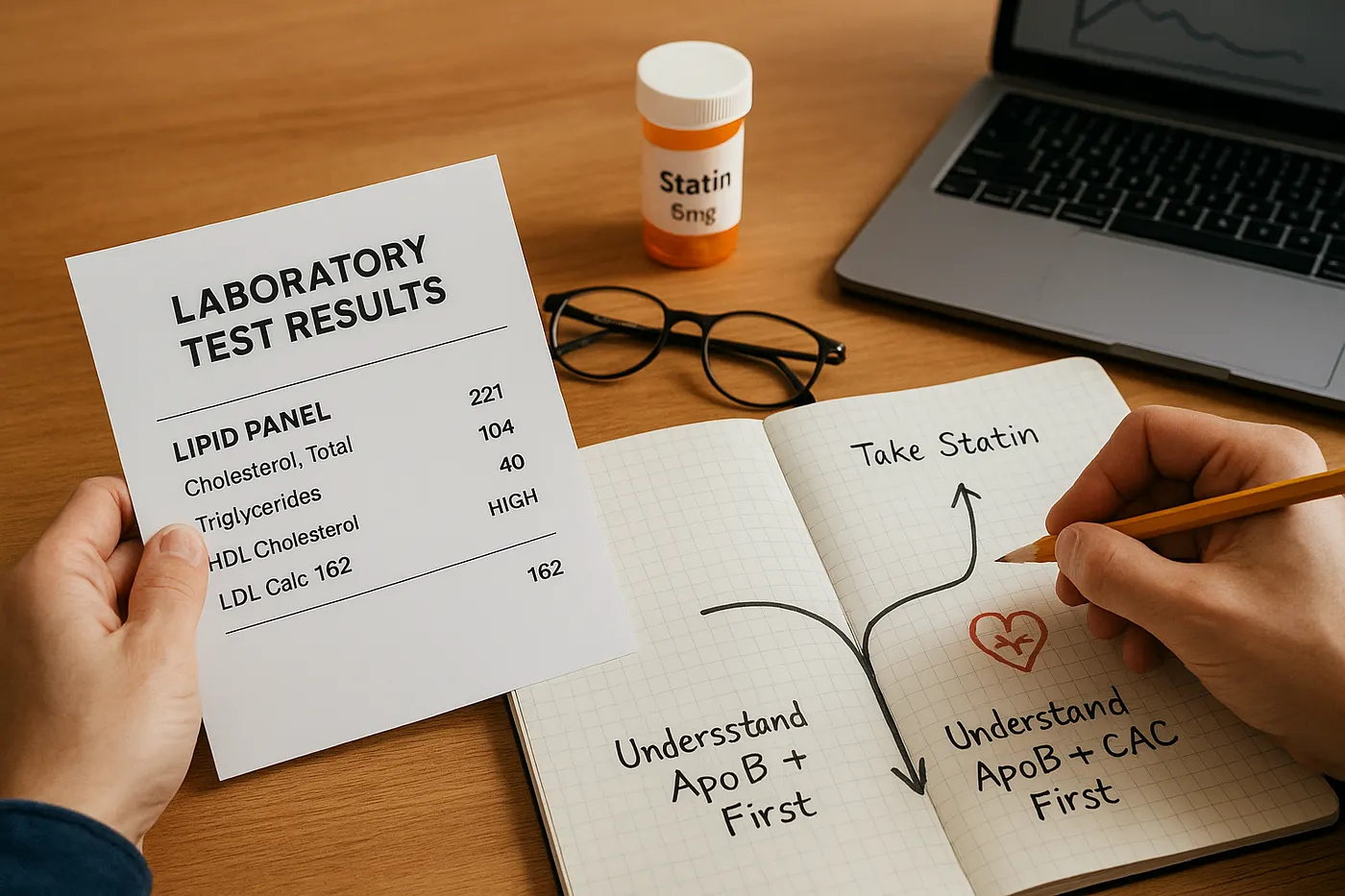
  • Total Cholesterol: 221
  • Triglycerides: 104
  • HDL: 40
  • LDL (calculated): 162

Total cholesterol never impressed me much. As Dr. Robert Lustig likes to say: “Total cholesterol, throw it in the garbage. It means absolutely nothing… you need to know what kind of cholesterol you’re talking about.”

Still, 162 for LDL is not the kind of number you frame on the wall, and my primary care physician reacted exactly as modern protocols expect her to.

Within hours of the lab results, she had electronically sent a prescription for statin. The pharmacy messaged me almost instantly: “Your medication is ready for pickup.”

Appointments may take weeks, but prescriptions fly at fibre-optic speed.

The Oct 21 Confession

At my annual physical on October 21, I decided to be honest.

“Doctor,” I said, “I never took the statin you prescribed last year.”

Her face went into that familiar expression that doctors reserve for engineers, lawyers and people who Google too much.

Last year (2024), she had prescribed 10 mg of statin. I quietly ignored it and, instead, started fasting regularly, shifted to two meals a day, and tried to fix the inputs before accepting a lifelong pill.

She listened, sighed, and said something to the effect of: “If your lipid panel is still bad this year, I will prescribe it again — and this time you really must take it.”

Fair enough.

But when I opened this year’s prescription, I noticed something that instantly activated my engineering brain:

  • 2024: Statin 10 mg (never taken)
  • 2025: Statin 5 mg

So without taking any statin at all, just by changing lifestyle, I had apparently earned a 50% dose reduction.

The engineer in me immediately plotted a mental graph: keep fasting, extend the trend line, and maybe next year the dose is… 0 mg?

Is this exactly how medical dosing works? Of course not. But try telling that to an engineer who just discovered a pattern.

The Internal Debate: Pill Now or Data First?

That’s when the real dilemma started. A familiar internal argument began between “Obedient Patient” and “Annoying Engineer.”

Questions began to swirl:

  • Can fasting and lifestyle alone bring LDL to a safer range?
  • Is LDL-C by itself enough to justify a lifelong medication?
  • Are my LDL particles mostly small and dense or large and floaty?
  • Shouldn’t I understand more before agreeing to a daily pill for the rest of my life?

Biology may be complex, but engineers are stubborn. We like to see the whole diagram before we press “Run”.

So I did what any 2025 engineer would do: I asked a few trusted AI tools, read several articles and listened to some long-form discussions on lipids.

The recurring message was clear:

LDL-C alone doesn’t tell the full story.

The Missing Pieces Behind LDL

This is where two other characters walked onto the stage: a deeper look at particle numbers and a better way to see whether plaque is actually forming in the arteries. Let’s just call them “advanced blood markers” and “artery imaging” for now, to keep things simple.

The idea that really clicked with my engineering mind was this:

  • One set of tests can tell you how many potentially troublesome particles are circulating.
  • Another test can show if those particles have actually started building plaque on your artery walls.

In other words, one tells you about risk potential, the other shows the actual damage so far.

That combination felt much more satisfying than a single “LDL 162 → take statin” rule.

Why These Extra Tests Matter (Especially to an Engineer)

Think of it this way:

  • Your standard lipid panel is like looking at the total number of cars entering a city.
  • The advanced markers tell you how many of those cars are heavy trucks with dodgy brakes.
  • The artery imaging tells you whether there are already traffic jams and accidents inside the city.

If my “traffic report” shows both a high number of risky vehicles and proof of actual pile-ups inside the arteries, then statins make much more sense to me.

But if the traffic looks busy on paper and, on imaging, the roads are still clear… then it becomes a very different conversation.

Why Am I Doing This and Not Just Obeying?

I often ask myself: why should patients have to reverse-engineer their own treatment plan?

Medicine still runs a lot on statistical averages and guidelines written for populations. But I am not a population. I am a single data point with my own history, habits, genes and quirks.

Yes, doctors must worry about legal risk. Yes, guidelines are written to be safe for the majority. But those of us who think in spreadsheets, graphs and decision trees crave a bit more personalization.

And, most importantly, if I am going to take a pill every day for the next several decades, I want to be absolutely sure I am taking it for the right, well-understood reasons.

When Silicon Valley Meets Artery Valley

Engineers spend years debugging code and chasing down intermittent faults in systems. Our instinct is always:

“Don’t just reboot. Find the root cause.”

So when my LDL came back elevated, I couldn’t just “reboot” by swallowing a statin and hoping for the best. I wanted to profile the system, inspect the logs, and understand whether the real bottleneck was lifestyle, genetics, inflammation, or early plaque buildup.

That doesn’t mean I am anti-medicine. It just means I prefer to read the full specification sheet before I sign up for a lifetime contract.

So What’s the Plan?

Here’s my next step:

  • Get the additional blood markers that go beyond standard LDL-C.
  • Get an imaging test that can show whether there is already plaque in my coronary arteries.
  • Then, sit down with my doctor and decide, with real data, whether statin is the right move for me now.

If those tests show that my arteries are already paying the price, I will have no hesitation in starting the medication. At that point, it won’t feel like surrender; it will feel like a data-driven decision.

If, on the other hand, the tests show that my risk is relatively low despite the LDL number, then I may get a bit more time to double-down on lifestyle, fasting and other non-pharmaceutical levers.

Either way, the decision will be anchored in much more than a single number on a lab report.

And because I’m still an engineer at heart, I am also sketching a simple little decision framework for myself — almost like a flowchart for cholesterol choices. I’ll share that in Episode 5, once I have my own test results in hand so that you can see how the logic plays out on real data instead of just theory.

Your Turn

If your doctor has ever prescribed a medication for cholesterol, did you:

  • Start it immediately and trust the recommendation?
  • Or did you pause, research, and look for more data the way I’m doing now?

I’d love to hear what you did — and whether you’d make the same decision again with what you know today.

In the meantime, I’ll be out here debugging my own biology, one lab report at a time.

⚠️ Author's Note

These reflections come from an engineer who started learning human biology far too late in life — mostly out of curiosity, partly out of necessity. What began as an attempt to outsmart blood sugar turned into a crash course in metabolism, ratios, and resilience. I’m not a doctor, and this isn’t medical advice. Please consult your physician before experimenting with fasting, diet tweaks, or supplement changes. Think of this as a mid-life engineering project on the body’s operating system — one where trial, error, and humility are all part of the lab work.

Thursday, November 13, 2025

The Rear-View Mirror Man : Celebrating the Enduring Warmth of Tara Chacha


The news of Tara Chacha passing, shared by my wife around noon, here, in Bay Area, California, delivered a surprising, piercing jolt. It wasn't the shock one feels upon losing a constant, daily fixture, rather, it was the profound realization that a foundational piece of one's personal, emotional geography, a landmark only glimpsed occasionally, but relied upon for orientation had suddenly been removed. He was never close in the mundane, day-to-day sense, yet the news stopped me in my tracks today, because the man himself was anything but mundane.

My first sighting of Tara Chacha occurred during my own wedding in 1993, which, for any groom, is a state of mind best described as beautiful, white-knuckle chaos. I wasn't focused on assessing the extended family hierarchy. I was entirely preoccupied with the far more pressing matter of ensuring I didn't set my sehra on fire or trip over the sacred coconut. Consequently, his towering presence was, regrettably, lost in the moment. Yet, years later, I realized something essential about him had been lodged firmly in my rear view mirror - a perfect, clear snapshot of a presence that, once seen, was impossible to forget. It is in that mirror that I’ve kept him for the last three decades, and the glass has never once fogged.


The Economics of Affection: A Portfolio of Impressions

The irony is that I may have interacted with him in person only five or six times over the course of three decades, yet each meeting was a high-yield investment, leaving me with returns in affection, warmth, charm, and grace that have sustained me far longer than any fleeting memory from that chaotic wedding day.

Tara Chacha was a master of presence. His physical stature : tall, well-built, and handsome combined with his booming voice, was an immediate command for attention. But the true genius lay in how he used it. He commanded respect not by demanding it, but by radiating a calm, accommodating nature that invited everyone into his orbit without ever imposing his will. He exhibited carefree attitude, but never careless. He was reasonable, yet utterly magnetic.

He had the rare ability to make you feel as though the moment you shared was the most important event of the day. In my forst couple of meetings, he loved reciting stories of his days spent in Jamshedpur. For me, a former management trainee at Tata Motors (then Telco) who had also walked the storied streets of the city, those anecdotes were not just stories; they were a mutual language. He would lean in, eyes alight, describing a time when work felt less like a job and more like building a destiny, a concept I could instantly relate to, making me feel less like a relative-by-marriage and more like a junior colleague.

In many beautiful respects, his spirit mirrored that of my own sanjhle papa (my 3rd Chacha). Both possessed that innate, almost gravitational ability to immediately light up the entire surroundings. They had the kind of genuine exuberance that made you put your phone down and listen. I imagine his life, the years in Jamshedpur, the responsibilities, the raising of a family was not always easy, but he wore his experiences with the grace of a seasoned traveler who appreciates the journey more than the destination. That is the true fantasy his image helps me construct - a life lived not by avoiding complexity, but by mastering the art of joyful engagement.


Dariyapur: The House that Radiates Warmth (And Witty Chaos)

Now we arrive at our family’s epicenter and that is Dariyapur, my in-laws’ ancestral home.

I must confess that while Dariyapur is my wife's maika, I hold a deep love for that cluster of houses and its gola in Patna, not out of spousal duty, but because of its rich, layered, and storied history. That place has a certain untranslatable laissez-faire, a distinct, chaotic, yet absolutely irresistible charm that makes it feel more like a living monument than a mere residence. The sheer layered history that place carries makes you envious and proud at the same time. And this, truly, is the crux of Dariyapur’s magic. 

While the warmth is certainly fueled by the wonderful people who currently reside there, it is magnified manifold by the invisible embrace of the spirits of those who are no longer with us. It is their residual kindness, their non-judgmental acceptance of the 'outsider' (me!) 32 years back, that allows the invisible warmth to endure. It’s a testament to the character of the generations who built that home, and Tara Chacha was certainly one of its storied resident who spent a significant amount of his time there.

Tara Chacha’s connection to Dariyapur was the stuff of legend. My wife, and my sister-in-law, all used to share how he would constantly reminisce about his life there. Even in his later years, as his memory began its cruel, inevitable retreat, the mention of Dariyapur was the password that lit up his eyes. I witnessed this first-hand a few years ago during a meeting in Delhi. The name of the house wasn't just a place, it was an anchor to his entire being. He may have traveled the world and lived a grand life, but Dariyapur was the home port of his soul.

It is for this very reason that the history of that house - the tales, the triumphs, the towering personalities that have graced with their presence with all the simple daily dramas must be chronicled for posterity. Someone more closely connected with that house must take on that responsibility, ensuring that its history and the spirits that infuse it with warmth are not lost to the shifting sands of time.


The Enduring Bond of Shared Kinship

My wife naturally carries more exquisite, detailed memories of her Chacha, memories formed over a lifetime of interaction and she often shares them, painting a picture of his tall personality that only confirms my own distant impressions. But for me, Tara Chacha served a unique and deeply personal role. While I never had the incredibly good fortune of meeting my father-in-law, I always, privately, positioned Tara Chacha in his place.

This was not a conscious replacement, but a natural, invisible transference of respect and affection. He possessed the same stately wisdom, the generous nature, and the commanding presence that I had only heard described of my late father-in-law. This created a profound, enduring, and utterly invisible bond that I hold dear.

We will not dwell on the closing chapter, but rather raise a toast to the extraordinary quality of the life he led. He was, in every sense, a masterclass in human presence, demonstrating that genuine charm is the beautiful equilibrium found in accommodating the world without ever compromising one's own dignity. He gifted us the indelible reminder that the true measure of a man is not his worldly accumulation, but the enduring warmth he distributes.

May his spirit assume his rightful post as one of the benevolent, charming guardians of Dariyapur, ensuring his light remains a clear fixture in all our rear-view mirrors. His was a life beautifully lived, and his memory will forever stand as a beacon of enduring values.

May his soul find eternal peace 💐Om Shanti🙏🏼

Tuesday, November 4, 2025

🩸 When Numbers Tell Stories: My Annual Blood Report Meets Twice a Month Fasting (Part 3 of “A Journey to Outsmart Blood Sugar”)

For most people, November means pumpkin pies, Diwali sweets, or early-bird Black Friday dealsFor me, it’s a combo of Halloween hangover and health homework.

While everyone else is finishing leftover candy and bragging about their costume photos, I’m opening my LabCorp report which, let’s be honest, is scarier than any haunted house. 🎃

This is my version of a Halloween sequel: “Return of the Lab Report. Except the ghosts here have names like LDL, Triglycerides, TSH and they never fail to haunt me every November.

This year, though, I had reasons to be hopeful. For over a year, I’ve been fasting twice a month (36–44 hours each time) and, for the last two months, I’ve downsized from three meals a day to two.

Basically, I’m running a low-budget metabolic startup, testing whether patience, not pills, can fix my biochemistry.

The Good, the Bad, and the Boring (data do not lie)


The Sugar Story: A Quiet Victory

Dr Robert Lustig famously says, “It’s not about calories — it’s about insulin.”
Looks like my pancreas agrees.

By sticking to two eating windows and giving my body longer rest periods, my HbA1c fell from 5.9 to 5.5. No drugs, no supplements, just restraint (and a stubborn streak).
Fasting Glucose held steady at 92 mg/dL, which means fewer glucose spikes and more stable energy.

If there were a Fitbit for insulin, it would’ve thrown confetti.

The Fat Files: Where LDL Thinks It’s the Hero

Here’s where the comedy begins. My LDL climbed from 154 to 162, nudging total cholesterol over 220.

Before anyone panics, let’s borrow Dr Lustig’s metabolic math:

  • It’s the TG : HDL ratio, not total cholesterol, that hints at insulin resistance.
  • Under 2 is great, 2–3 acceptable, over 3 = metabolic traffic jam.

Mine? 2.6. Not bad, just a polite nudge to “keep running / hiking /walking /Swimming or whatever you like to move your body for.”

So while LDL strutted around, my triglycerides stayed low and HDL didn’t desert me. Lustig would likely pat me on the back and say, “Your liver’s still got its act together — just stop feeding it fructose.”

The Liver Whisper

My ALT and AST stayed normal, meaning my fasting didn’t stress the liver.
Lustig often points to the ALT : AST ratio — when ALT > AST by a lot, it hints at fatty liver.
Mine were well-balanced, so the internal refinery is functioning efficiently — probably because I stopped supplying it with midnight snacks to process.

Press enter or click to view image in full size

The Vitamin D Drama

Now, the real underachiever: Vitamin D 16 ng/mL.
Apparently, fasting indoors does not stimulate solar synthesis.
Even Dr Lustig’s “sunshine hormone” can’t thrive on willpower alone.
Note to self: step outside occasionally or buy those elusive D3 capsules that keep showing up in the Amazon cart.

Press enter or click to view image in full size

What the Trends Whisper

Improved

  • HbA1c ↓ 5.9 → 5.5 : Stable glucose, better insulin sensitivity
  • B12 creeping upward

Holding the Line

  • Liver, kidney, PSA — quiet performers doing their job

Needs Nudging

  • LDL ↑ 162 mg/dL (watch the cheese board)
  • Vitamin D low → get more sunshine
  • TG : HDL 2.6 → keep fasting rhythm steady

Lessons (with a grin)

  1. Two Two Meals > Three Temptations
    Who knew eating less often could feel more freeing? My glucose graphs now look like calm sine waves instead of jagged ECG spikes. Apparently, the body runs smoother when it isn’t treated like a vending machine.
  • Ratios > Raw Numbers
    As Dr. Lustig says, numbers lie but ratios tell the truth. The TG : HDL and ALT : AST ratios are like health’s debugging logs. They reveal what the pretty dashboard won’t.
  • Sunlight > Supplements
    Vitamin D taught me that even the most data-driven person can’t photosynthesize under fluorescent lighting. Step outside. The sun’s API is free.
  • LDL Needs Coaching, Not Condemnation
    My LDL may be stubborn, but maybe it’s just trying to protect me from my own enthusiasm for buttered toast. In engineering terms: it’s running in “defensive mode.”
  • Discipline > Perfection
    Fasting isn’t a punishment; it’s scheduled maintenance. Like a system reboot — brief downtime, smoother performance afterward.
  • Curiosity Never Retires
    It took me decades to realize that biology is just another operating system except you can’t replace the hardware. So I tinker gently and debug patiently.

Final Reflection

Fasting, to me, isn’t punishment — it’s pressing “Reset” twice a month.
Going from three meals to two made my metabolism hum instead of wheeze.

From 2017’s sugar roller-coaster to 2025’s metabolic jazz, the trend is clear: discipline outperforms diet fads.

Twice-monthly fasting has stabilized my glucose, sharpened focus, and kept inflammation quiet.

Now, the plan is simple: keep the sugar steady, charm HDL into rising, convince LDL to behave, and maybe — just maybe — step out into the Californian sun before sunset.

Because as Dr Lustig might say,

You can’t hack biology — but you can negotiate with it, one fast at a time.”

⚠️ Author’s Note

These reflections come from an engineer who started learning human biology far too late in life — mostly out of curiosity, partly out of necessity. What began as an attempt to outsmart blood sugar turned into a crash course in metabolism, ratios, and resilience. I’m not a doctor, and this isn’t medical advice. Please consult your physician before experimenting with fasting, diet tweaks, or supplement changes. Think of this as a mid-life engineering project on the body’s operating system — one where trial, error, and humility are all part of the lab work. 

Sunday, November 2, 2025

A Review of David Sinclair's "Lifespan" - Why Aging Might Be Optional 

 Time, meet Biology

Dr. David Sinclair, a Harvard geneticist and one of Time magazine’s 100 Most Influential People (2014), doesn’t just study aging , he’s trying to bully it into submission. In Lifespan, he argues that aging is a disease, and more importantly, that it’s treatable. Yes, Mother Nature might file a complaint, but Sinclair’s case is compelling.

The book unfolds in three acts  of Past, Present, and Future chronicling how humanity has viewed aging through time. He weaves hard science with personal anecdotes and philosophical musings to build a daring idea: that humans could live 120–150 years of healthy life, and even beyond, with minds sharp enough to remember why we walked into the kitchen. Remember the mythological ageas of sages in India living to 1000 years or so.


The Thesis, Without the Jargon

  • Aging drives most chronic diseases. If you slow aging, you delay the parade — cancer, diabetes, Alzheimer’s, heart disease.
  • Personalized medicine is here. Thanks to cheap DNA sequencing, wearable sensors, and AI, we’re moving from “what works for most” to “what works for you.”
  • Funding still lags. Only a handful of nations treat aging as a legitimate medical target. It’s like discovering fire but deciding sweaters were enough.


The Science (in Plain English)

The author’s core idea is what he calls the Information Theory of Aging.
Our DNA, the “hardware,” stays largely intact throughout life. But the “software”, the epigenetic code that tells our genes what to do, becomes corrupted over time, like scratches on an old CD. As a result, cells forget their identities: liver cells start acting confused, nerve cells forget their duties, and tissues lose harmony.

The Repair System That Saves Us

Every cell comes equipped with a survival circuit, powered by genes known as sirtuinsAMPK, and mTOR. These genes spring into action when the body faces stress — fasting, cold, heat, exercise.
When life is too easy (constant food, comfort, and warmth), these genes go on vacation.
Ironically, mild hardship keeps us young.

The author highlights how today’s medicine is already experimenting with futuristic tools like:

  • CAR-T therapy: Doctors engineer immune cells to hunt down cancer, giving your body its own precision army.
  • Single-cell sequencing: Scientists can now read the full DNA of individual tumor cells, mapping how they mutate over time — a leap toward true personalized cancer treatment.

He also reveals that many chronic illnesses share a common root cause: aging itself. Treat the aging process upstream, and you may prevent a dozen diseases downstream.


Five Ways to (Politely) Annoy Death

(Sinclair’s practical, research-grounded tactics you can start now — no immortality ring required.)

1. Fast — Strategically

Not starvation, not malnutrition. Intermittent fasting nudges your cells into repair mode, activating genes that clean up damage. Hunger might make you cranky, but so does arthritis.

2. Eat Less Often (Not Necessarily Less Food)

People in longevity hotspots like Ikaria, Greece, often skip breakfast and eat modestly, saving large meals for evening. The result: a community where turning 90 is just halftime.

3. Favor Plants Over Meat

If longevity had a mascot, it would be a rabbit, not a lion. Studies show replacing animal protein with plant protein reduces all-cause mortality. Don’t worry  as nobody’s confiscating your barbecue tongs.

4. Exercise Like Your Telomeres Are Listening

Those who jog or walk briskly for 30 minutes a day can have telomeres , the caps protecting DNA  that look nearly a decade younger. Move it, or lose it, literally.

5. Get Comfortable Being Uncomfortable

Cold showers, ice dips or winter walks  - any short bursts of discomfort awaken your longevity genes. Your future self will thank you; your present self will scream in the shower.


Sinclair’s Longevity “Stack” (Not Medical Advice)

Sinclair admits he’s his own lab rat and shares what he is doing, but his regimen mirrors emerging longevity science:

  • Supplements: NMN, resveratrol, metformin, plus vitamins D and K₂, and low-dose aspirin.
  • Diet: Mostly plant-based, minimal sugar. Dessert is a once-in-a-blue-moon heist.
  • Routine: Regular bloodwork, daily steps, weekend gym sessions, sauna and cold plunge rotation.
  • Lifestyle: Cooler rooms, lean body mass, plenty of mental and social stimulation.


The Subplots: Politics, Society, and the Future

The author draws surprising links between aging and politics, noting that nationalist movements often resonate with older demographics clinging to the past. When most politicians are well past their biological warranty, policy can suffer the same senescence as their cells.

He also speculates on the future of a world where lifespans extend dramatically:
Will inequality deepen if longevity tech is expensive?
Will retirement disappear?
And how will we handle the moral challenge of having more life and more responsibility?


The Vision Ahead

The future, the author paints is provocative but plausible:
With advances in epigenetic reprogramminggene therapy, and AI-driven health monitoring, humans could one day reset their biological clocks. His lab even managed to restore sight in old mice by rejuvenating optic nerves (one of the nerves that cannot be regenerated if lost), a glimpse of what reversing age might mean.

He doesn’t promise immortality; he promises more time spent healthy, curious, and mobile.
The goal is not to live forever but just long enough to enjoy the ride without the brakes giving out.


Final Thoughts

Lifespan isn’t just a book about biology. It’s a wake-up call about our choices, a roadmap for extending not just years but quality of life. It challenges the fatalistic notion that aging is inevitable and reframes it as something we can study, slow, and perhaps one day, reset.

You can’t negotiate with death,
but thanks to science, you can renegotiate the terms. Loved reading this book.


Saturday, October 25, 2025

When Fasting Met Blood Donation — An Accidental Experiment

Part 2 of my ongoing experiments in fasting — connecting data, discipline, and a dash of curiosity.
What happens when fasting meets a blood donation drive? A small experiment in curiosity, restraint, and how the body adapts.

In my previous story, I wrote about experimenting with fasting, exercise, and lifestyle tweaks to outsmart my blood sugar, not as a health guru, but as an engineer curious about how the body responds to small system changes.

I’m still waiting for my next set of blood tests on October 28 to see if some of those biomarkers have actually improved. But while I wait for data, another unexpected event added a fresh chapter to this ongoing exploration.

An Overlap I Didn’t Plan

It began with a scheduling coincidence. I had signed up to donate blood on October 17, only to realize later that it was also Ekadashi, my fasting day.

My first instinct was to reschedule. But then the little engineer in me whispered, why not observe what happens?

I’ve always believed that real understanding comes from first-hand data, not assumptions. So I decided to let fasting and blood donation meet — purely for the sake of curiosity.

At the Church Lab (Also Known as the Blood Drive)

The Red Cross had set up a donation camp at a local church. After the standard checklist — travel, medications, iron levels, caffeine intake, and possibly whether I’d recently lived on Mars — I mentioned casually to the nurse:

By the way, I’m fasting today. Is that okay?

She gave me the kind of look nurses reserve for over-confident donors.
“Yes, but you might feel dizzy. You can always come back another day,” she said gently.

That was all the encouragement my inner tinkerer needed.
“Let’s try it,” I replied. “You can keep me under observation. Worst case, I pass out gracefully.”

She smiled — the professional mix of concern and amusement — and agreed to keep an eye on me.

The Outcome (Spoiler: I Survived)

Everything went smoothly.
No dizziness, no tunnel vision, no dramatic Bollywood-style faint.
I rested for ten minutes, sipped some water, and then drove home — feeling oddly light and focused.

By the time I have completed this post, I’d been fasting for around 48 hours, drinking only water. No hunger pangs, no weakness. Just a steady calm as if the body had tuned itself to a more efficient frequency.

I even managed nine rounds of Sun Salutation this morning, which might explain why the nurse kept checking if I was still upright.

What I Learned

Donating blood while fasting, at least for me, felt no different from donating on a regular day. That said, our bodies speak in different dialects and it’s wise to listen closely for signs of distress.

For me, this experience became another data point in my ongoing fasting experiment. I’ve now completed three 48-hour Ekadashi fasts in the past two months. The pattern is becoming clearer:

The busier I stay, the less I feel like eating.

Fasting, I’m realizing, isn’t about deprivation, it’s about redirection.
Energy, focus, and even curiosity seem to reboot when the digestive system takes a break.

No medical advice here, just one engineer’s continuing fascination with how the body behaves under simple constraints. This time, the “test” involved missing a few meals and donating a pint of blood.

Next up: those post October 28th blood test results. Let’s see if the system shows measurable improvement or just more interesting data.

So far, the system’s stable. No warning lights yet. Let’s stay curious and stay connected.