Showing posts with label Fasting. Show all posts

Monday, August 31, 2026

Episode 6 - When My Kidneys Filed a 2 AM Complaint for 2 Meals a Day

 Another field note from an engineer who discovered that simplifying the meal schedule does not necessarily simplify the plumbing.


If you are new to this journey

If you have not had a chance to read my earlier posts, I recommend starting from Episode 1 and following the journey in sequence. Each episode led naturally to the next one, much like debugging a system where every fix seems to uncover another interesting problem.

Here are the five episodes so far:

Episode 1: A Journey to Outsmart Blood Sugar (Before It Outsmarts Me)

Episode 2: When Fasting Met Blood Donation: An Accidental Experiment

Episode 3: When Numbers Tell Stories: My Annual Blood Report Meets Twice a Month Fasting

Episode 4: An Engineer’s Dilemma: Should I Debug My LDL or Just Take the Statin?

Episode 5: The Decision: When a CAC Score of 18 Stopped Being Just a Number

If you have already read them, you can skip the history and proceed directly to my latest experiment.


The Two Meal Experiment

If you have been following my attempt to outsmart blood sugar, you know that I have gradually turned my body into a small personal biochemical laboratory.

There are the muscle sponge experiments, where 20 squats or 30 push ups after a meal can bring my glucose down quite noticeably.

There are my 9 rounds of Sun Salutations every morning.

There are twice a month Ekadashi water fasts.

And somewhere along the way, in year 2026, something else became surprisingly natural.

I started eating two meals a day instead of three.

There was no grand strategy behind it. I simply discovered that I did not really miss the third meal.

My usual schedule had been roughly 9 AM for the first meal and 3 PM for the second and final meal.

The routine was simple.

The spreadsheet looked good.

My glucose numbers seemed happy.

So naturally, I assumed the system was working beautifully.

Then my kidneys filed a complaint.

The 2 AM Problem

I started waking up around 2 or 3 AM with an urgent message from the internal plumbing department.

Bathroom. Now.

There was no snooze button.

No negotiation.

Just a very clear biological command.

At first, I wondered whether this was simply another privilege that comes with getting older. Perhaps my bladder had decided that it too deserved a more active role in my life.

And then there was the obvious possibility that any man of my age is expected to consider:

The prostate.

I am not qualified to diagnose which department is misbehaving, so I am not going to promote myself from engineer to urologist overnight.

If my prostate is planning a rebellion, I will let my doctor investigate that during my regular physical rather than trying to diagnose it from my bedroom.

Until then, I decided to look at the evidence.

And the evidence produced an interesting clue.

One evening, instead of having my second meal at around 3 PM, I had a light meal at about 7:30 PM.

I even drank water until around 9 PM.

I fully expected my bladder to send me an even more enthusiastic invitation at 2 AM.

It didn't.

I slept through the night.

That got my attention.

One night is not a scientific study, of course. But it was enough to make me wonder whether the problem was not two meals a day itself, but perhaps the very early timing of my second meal.


What Could Be Going On?

This is where my curiosity kicked in.

If eating at 7:30 PM and drinking water until 9 PM did not result in a 2 AM bathroom visit, why was finishing my second meal around 3 PM apparently different?

There is a plausible physiological explanation, and it has less to do with the amount of water I drink than I initially thought.

When we eat, insulin rises. One of insulin's many jobs is to tell the kidneys to retain sodium. When we go for a longer period without food, insulin levels fall. With lower insulin, the kidneys can start excreting more sodium. This process is called natriuresis.

And here is the important part:

Water tends to follow sodium.

So when the kidneys decide to send more sodium out, they can send more water along with it. The result can be increased urine production.

There is another piece to the puzzle. Our body stores carbohydrate as glycogen in the liver and muscles, and glycogen is stored together with water. As the body uses some of that glycogen during the long gap between meals, some of the associated water is released and eventually needs to be excreted.

Normally, the body has another clever nighttime mechanism to prevent all this from turning into a midnight bathroom expedition. As we sleep, the hormone vasopressin, also known as antidiuretic hormone, rises and tells the kidneys to conserve water and produce less urine.

So, in simple terms, there are two competing instructions:

“We are sleeping. Save the water.”

versus

“There has been a long gap since the last meal. We can let some sodium and water go.”

I am obviously simplifying a much more complicated physiological system. But it helped me understand why my meal timing could potentially matter.

When my second and final meal was around 3 PM, there was a very long interval before bedtime and an even longer interval before breakfast the next morning. When I moved that meal to 7:30 PM for my little experiment, that interval became considerably shorter.

And despite eating later and drinking water until 9 PM, I slept through the night.

That does not prove that the earlier meal timing was causing my nighttime urination. There are many possible reasons someone might wake up to urinate, including prostate and bladder issues, fluid intake, medications, sleep patterns and other medical conditions.

I also did not measure my overnight urine volume, sodium excretion, insulin or vasopressin.

So I am not qualified to diagnose which department is misbehaving, and one experiment certainly does not qualify me to promote myself from engineer to urologist overnight.

But I did have something useful: a repeatable observation and a reasonable hypothesis.

Perhaps my two meal routine is perfectly fine, but the 3 PM timing of my second meal is not ideal for my sleep.

And that is enough for this engineer to run the next experiment.


The Next Experiment

That experiment has now given me an idea.

I am considering moving my two meals from my usual 9 AM and 3 PM schedule to something closer to:

First meal: around 11 AM

Second and final meal: around 6 to 7 PM

The 7:30 PM experiment was encouraging because I slept through the night despite eating later and drinking water later.

Now I want to see whether moving my regular meal timing in that direction will make a difference consistently.

I have not declared victory.

I have not even changed the system completely yet.

I am simply making the next adjustment and watching what happens.

And that outcome will have to wait for the next episode.

The Rest of the System Remains

Nothing else in the experiment needs to be thrown out.

The squats remain.

The push ups remain.

The Sun Salutations remain.

The two meal routine remains.

And the twice a month Ekadashi fast remains.

Only the timing of the two meals is now under review.

This is probably another example of something I have learned repeatedly during this journey.

The human body is not a spreadsheet.

You can optimize one variable and discover that another department has opinions.

I started by trying to improve blood sugar.

Then came cholesterol.

Then ApoB.

Then my CAC score of 18 reminded me that the cardiovascular system keeps its own historical records.

And now the kidneys have joined the conversation.

Apparently, they want a seat at the engineering review meeting too.

So the latest algorithm remains simple:

Measure. Observe. Adjust. Repeat.

I am not trying to make my body follow my spreadsheet.

I am trying to listen carefully enough to understand what the body is telling me.

And preferably, to understand it before 2 AM.


My system may be adjusting its timing before Daylight Saving Time, but the engineer still expects his quota of uninterrupted sleep.


Author's Note

These reflections come from an engineer who started learning human biology far too late in life, mostly out of curiosity and partly out of necessity. What began as an attempt to outsmart blood sugar has turned into a continuing experiment in metabolism, meal timing, data and resilience.

I am not a doctor, and this is not medical advice. Nighttime urination can have many causes, so persistent symptoms should be discussed with a healthcare professional.

Think of this as a personal midlife engineering project on the body's operating system, where trial, error and humility are all part of the lab work.

Tuesday, November 4, 2025

🩸 When Numbers Tell Stories: My Annual Blood Report Meets Twice a Month Fasting (Part 3 of “A Journey to Outsmart Blood Sugar”)

For most people, November means pumpkin pies, Diwali sweets, or early-bird Black Friday dealsFor me, it’s a combo of Halloween hangover and health homework.

While everyone else is finishing leftover candy and bragging about their costume photos, I’m opening my LabCorp report which, let’s be honest, is scarier than any haunted house. 🎃

This is my version of a Halloween sequel: “Return of the Lab Report. Except the ghosts here have names like LDL, Triglycerides, TSH and they never fail to haunt me every November.

This year, though, I had reasons to be hopeful. For over a year, I’ve been fasting twice a month (36–44 hours each time) and, for the last two months, I’ve downsized from three meals a day to two.

Basically, I’m running a low-budget metabolic startup, testing whether patience, not pills, can fix my biochemistry.

The Good, the Bad, and the Boring (data do not lie)


The Sugar Story: A Quiet Victory

Dr Robert Lustig famously says, “It’s not about calories — it’s about insulin.”
Looks like my pancreas agrees.

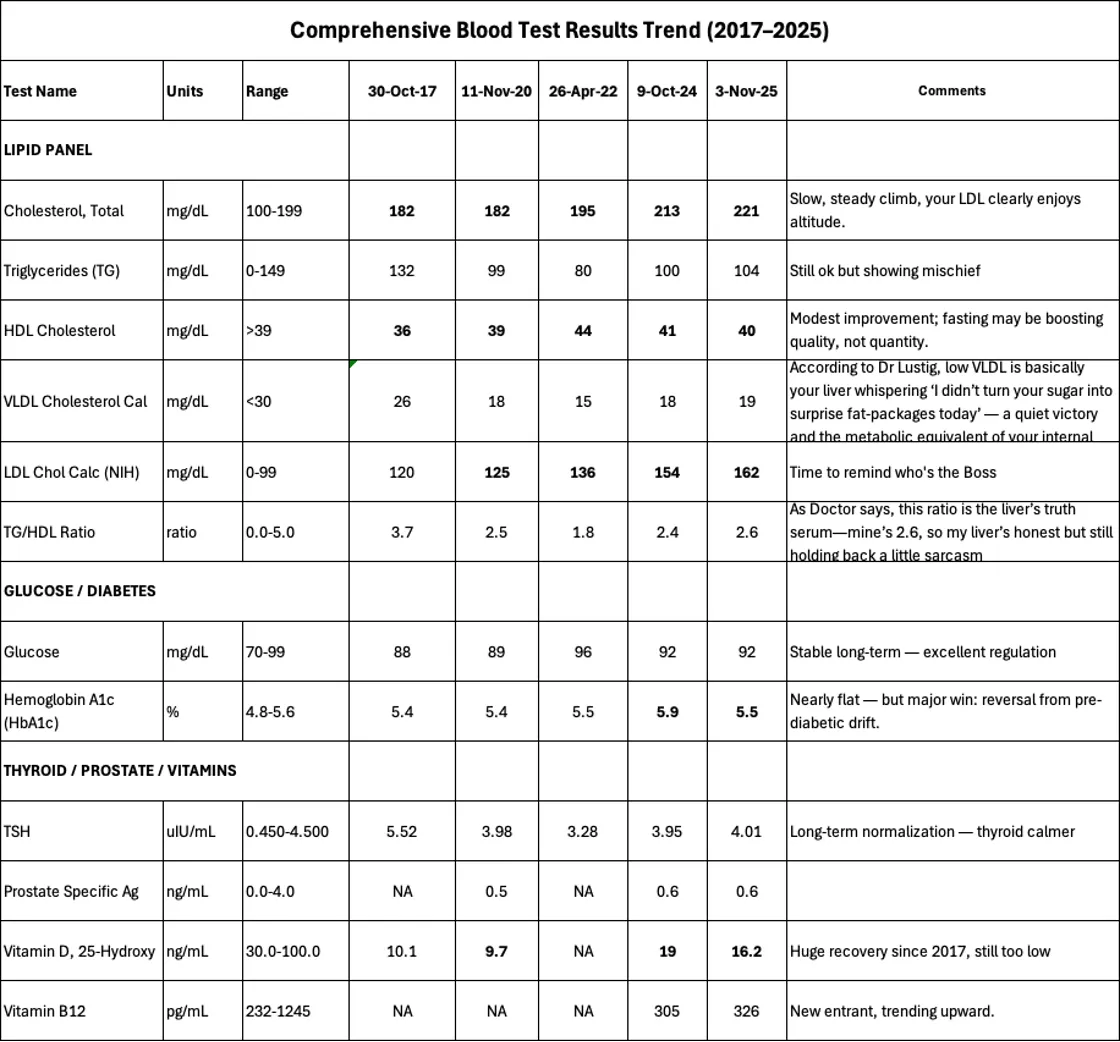
By sticking to two eating windows and giving my body longer rest periods, my HbA1c fell from 5.9 to 5.5. No drugs, no supplements, just restraint (and a stubborn streak).
Fasting Glucose held steady at 92 mg/dL, which means fewer glucose spikes and more stable energy.

If there were a Fitbit for insulin, it would’ve thrown confetti.

The Fat Files: Where LDL Thinks It’s the Hero

Here’s where the comedy begins. My LDL climbed from 154 to 162, nudging total cholesterol over 220.

Before anyone panics, let’s borrow Dr Lustig’s metabolic math:

  • It’s the TG : HDL ratio, not total cholesterol, that hints at insulin resistance.
  • Under 2 is great, 2–3 acceptable, over 3 = metabolic traffic jam.

Mine? 2.6. Not bad, just a polite nudge to “keep running / hiking /walking /Swimming or whatever you like to move your body for.”

So while LDL strutted around, my triglycerides stayed low and HDL didn’t desert me. Lustig would likely pat me on the back and say, “Your liver’s still got its act together — just stop feeding it fructose.”

The Liver Whisper

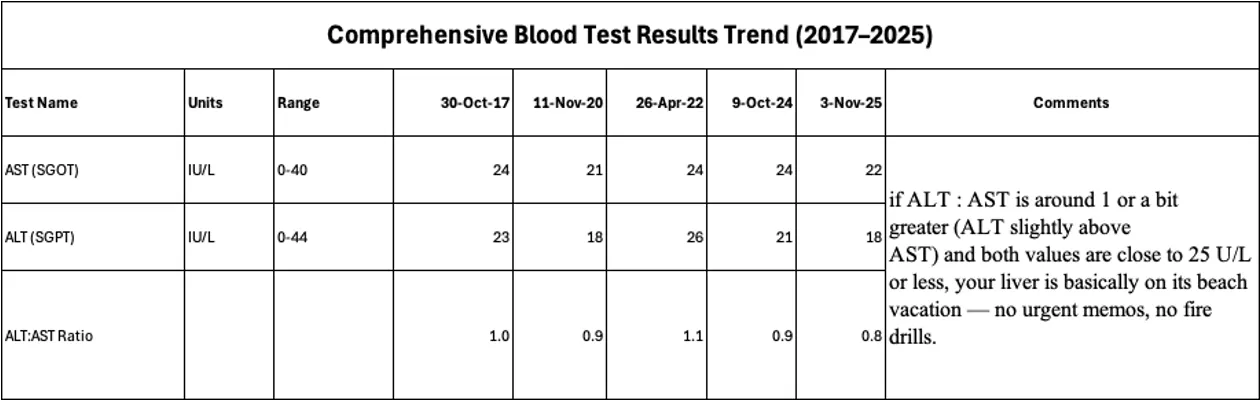
My ALT and AST stayed normal, meaning my fasting didn’t stress the liver.
Lustig often points to the ALT : AST ratio — when ALT > AST by a lot, it hints at fatty liver.
Mine were well-balanced, so the internal refinery is functioning efficiently — probably because I stopped supplying it with midnight snacks to process.

Press enter or click to view image in full size

The Vitamin D Drama

Now, the real underachiever: Vitamin D 16 ng/mL.
Apparently, fasting indoors does not stimulate solar synthesis.
Even Dr Lustig’s “sunshine hormone” can’t thrive on willpower alone.
Note to self: step outside occasionally or buy those elusive D3 capsules that keep showing up in the Amazon cart.

Press enter or click to view image in full size

What the Trends Whisper

Improved

  • HbA1c ↓ 5.9 → 5.5 : Stable glucose, better insulin sensitivity
  • B12 creeping upward

Holding the Line

  • Liver, kidney, PSA — quiet performers doing their job

Needs Nudging

  • LDL ↑ 162 mg/dL (watch the cheese board)
  • Vitamin D low → get more sunshine
  • TG : HDL 2.6 → keep fasting rhythm steady

Lessons (with a grin)

  1. Two Two Meals > Three Temptations
    Who knew eating less often could feel more freeing? My glucose graphs now look like calm sine waves instead of jagged ECG spikes. Apparently, the body runs smoother when it isn’t treated like a vending machine.
  • Ratios > Raw Numbers
    As Dr. Lustig says, numbers lie but ratios tell the truth. The TG : HDL and ALT : AST ratios are like health’s debugging logs. They reveal what the pretty dashboard won’t.
  • Sunlight > Supplements
    Vitamin D taught me that even the most data-driven person can’t photosynthesize under fluorescent lighting. Step outside. The sun’s API is free.
  • LDL Needs Coaching, Not Condemnation
    My LDL may be stubborn, but maybe it’s just trying to protect me from my own enthusiasm for buttered toast. In engineering terms: it’s running in “defensive mode.”
  • Discipline > Perfection
    Fasting isn’t a punishment; it’s scheduled maintenance. Like a system reboot — brief downtime, smoother performance afterward.
  • Curiosity Never Retires
    It took me decades to realize that biology is just another operating system except you can’t replace the hardware. So I tinker gently and debug patiently.

Final Reflection

Fasting, to me, isn’t punishment — it’s pressing “Reset” twice a month.
Going from three meals to two made my metabolism hum instead of wheeze.

From 2017’s sugar roller-coaster to 2025’s metabolic jazz, the trend is clear: discipline outperforms diet fads.

Twice-monthly fasting has stabilized my glucose, sharpened focus, and kept inflammation quiet.

Now, the plan is simple: keep the sugar steady, charm HDL into rising, convince LDL to behave, and maybe — just maybe — step out into the Californian sun before sunset.

Because as Dr Lustig might say,

You can’t hack biology — but you can negotiate with it, one fast at a time.”

⚠️ Author’s Note

These reflections come from an engineer who started learning human biology far too late in life — mostly out of curiosity, partly out of necessity. What began as an attempt to outsmart blood sugar turned into a crash course in metabolism, ratios, and resilience. I’m not a doctor, and this isn’t medical advice. Please consult your physician before experimenting with fasting, diet tweaks, or supplement changes. Think of this as a mid-life engineering project on the body’s operating system — one where trial, error, and humility are all part of the lab work. 
Saturday, October 25, 2025

A Journey to Outsmart Blood Sugar (Before It Outsmarts Me)

 An engineer’s experiment with fasting, food, and fitness sprinkled with dark humor and a dash of sugar paranoia.

A midlife engineer and lifelong foodie tries to hack his way out of blood sugar trouble, one fast, one squat, and one sarcastic thought at a time.

Experiment with FastingLet’s be honest — who doesn’t love sugar? Whether it’s the comforting sweetness of chai, a post-meal dessert, or that innocent-looking cookie that somehow disappears by the dozen, sugar is that one friend who makes everything better… until it doesn’t.

The problem is, sugar addiction is as real as it gets. The more you have it, the more your brain craves it. And giving it up? That’s no small feat. I sometimes think quitting sugar might be harder than quitting smoking or drinking — at least nobody offers you a slice of cake for refusing alcohol.

So here I am, a lifelong foodie and dessert enthusiast, trying to make peace with a hard truth: if I want to keep enjoying food without turning my bloodstream into syrup, I need to understand what’s happening inside me.

Maybe it’s my engineering background, but I like to approach these things rationally and proactively — more like a system to optimize, not a crisis to react to. I believe in data, logic, and a fair bit of curiosity. If my body’s running a complex biochemical network, I might as well treat it like one and see what tweaks improve performance. On top of this, a short call from my daughter once from her before visiting her physician to list who in our line of generations have been inflicted by this metabolic disorder.

That’s what led me down this rabbit hole: a personal experiment to understand and manage blood sugar before it manages me.

Like many folks sliding gracefully or, let’s admit it, reluctantly into their mid-50s, I’ve developed a new hobby to worry about aging. But instead of buying expensive supplements or quoting wellness influencers, I decided to do what any sensible, slightly reckless person would do and that is experiment on myself.

Before you imagine a Frankenstein setup with beakers and wires, let me clarify: I’m not a doctor, not a health guru, and certainly not offering medical advice. I’m just a curious human trying to see how long I can keep my blood sugar in check without giving up my favorite foods or my sanity.

The Fear of the Sweet Monster

I’ve always dreaded blood glucose. I don’t have diabetes (yet), but at 55+, I’ve watched too many friends fall victim to the “sweet curse.” Suddenly, their lives revolve around labels, carb counts, and saying no to gulab jamun. And it is also reasonable to say that most of them have been managing this beautifully with the right medicines and diet control.

For a lifelong foodie like me, that sounds like a culinary nightmare. If life’s worth living, it’s worth tasting, right?

My family history doesn’t exactly ease the paranoia. My late father never struggled with blood sugar until very late in life (thanks to some steroid use), while my mother has been managing diabetes for years — with the help of good old metformin.

Flirting with the Borderline

Last year’s blood test told me I’m skating on thin ice: an A1C of 5.5, sitting smugly at the edge between “normal” and “pre-diabetic.”

I’ve been a regular hiker, biker, and occasional runner (these days, running mostly means chasing Wi-Fi signals). For over 15 years, these activities have kept my numbers in check — without forcing me to say goodbye to biryani or pizza. But lately, I’ve hit a wall.

Despite my efforts, my regular morning fasting sugar floats between 85 and 100. Occasionally, I have seen it around 103 as well. Technically, under 100 is recommended, but I want to aim for the golden number — around 80. Because who doesn’t love a clean score, especially when your body’s the report card?

My Own Experience

Everything that follows — these lessons, experiments, and plans — comes from my own personal journey of trial, error, and occasional triumph.

Some are lessons I’ve learned the hard way, others are ongoing experiments that I’m still refining (or surviving). Think of them as field notes from one man’s attempt to outthink his metabolism.

I’m not promising miracles or medical breakthroughs — just honest observations and a desire to understand what truly works. My hope is that if you’ve ever stared at your blood test results with mild panic, you’ll find a bit of hope (and maybe a laugh) in what follows.

Lesson One: Exercise Is Great — Until It Isn’t

Here’s the first thing I learned: exercise works only up to a point.

If you’re in your 30s or 40s, you might outrun sugar with enough jogging and spinach smoothies. But in your 50s, especially if you’ve got a diabetic parent in the mix, the game changes.

At some point, exercise alone stops working. You plateau. Your sneakers still move, but your sugar numbers don’t. That’s when you realize that it’s not about “controlling food,” it’s about avoiding excess food.

A painful truth for foodies, yes, but denial spikes blood sugar faster than dessert.

Lesson Two: You Can’t Overstate the Power of Weight Training

My second discovery is brutally simple: incorporate weight training, especially once you cross 50. People tend to give this a passing look but of late many of us are realizing the physiological impacts behind such workouts.

I’ve learned that building muscle isn’t just for gym bros or selfie enthusiasts — it’s one of the most effective ways to lower blood glucose. Bigger muscles act like glucose sponges, soaking up sugar from your bloodstream.

It’s my personal experience that a simple set of 20 squats can drop your glucose by nearly 20 points. Thanks to my friend Naresh who initiated me in to this. Add 30 push-ups, and you can see a similar dip. The larger the muscle group you work, the more dramatic the immediate drop.

Personally, I’m not a fan of the gym (too much equipment, too many mirrors). So I’ve made peace with home workouts. My routine includes 9 rounds of Sun Salutations for flexibility first thing each day in the morning, and on alternate days, I switch between push-ups and squats.

I started with 20 reps of each at the top of every hour (which, honestly, was ambitious). These days, I’ve settled into a more sustainable rhythm — 3 sets of 15 reps, done at least three times a day. It’s simple, effective, and, most importantly, doesn’t require me to leave the house or tolerate gym music.

Lesson Three: The Dinner Deadline

My third realization is elegantly boring but incredibly powerful: eat dinner early.

Ideally, 3–5 hours before bed.

When I eat by 6:30 p.m., my fasting sugar behaves the next morning. When I push dinner to 9 p.m., my glucose throws a tantrum. Turns out, our bodies hate midnight snacks more than our dentists do.

Lesson Four: Two Meals Are Enough (Most of the Time)

I’ve recently started eating just two meals a day. It sounded impossible at first — like expecting a Bollywood movie to end in 90 minutes — but surprisingly, it feels great.

The first few days were tough. My stomach made noises that could scare a raccoon. But soon, I noticed sharper focus, better energy, and most importantly, less guilt compared to when I did eat. It’s like telling your body, “Hey, I’m the boss here.”

Lesson Five: Rediscovering Grandma’s Wisdom (and My Sense of Humor)

Now, here’s the fun part — or the fasting part, depending on your perspective.

Twice a month, I do a 24-hour water fast, usually on Ekadashi (try to find the meaning of this word on a lunar calendar), a tradition my maternal grandmother followed religiously. I used to tease her for it as a kid, joking that skipping meals was her secret way of trying to find me-time.

Now I realize she was onto something profound.

Skipping two days of meals a month means avoiding 6 out of 90 meals, giving your body about a 6.5% break from constant digestion. I’m now planning to stretch it to a 48-hour fast, doubling that to about 13% “meal-free” livingwithout compromising any routine day to day activities of work, exercise etc

It’s like giving your digestive system a weekend off — from you.

The Experiment Continues

My next annual blood test is on October 28, and I’m oddly excited. I’ll find out if these eight months of twice-monthly fasting have actually nudged my biological markers in the right direction — or if I’ve just been glorifying hunger with scientific jargon.

Either way, I’ve learned something valuable: aging doesn’t have to mean surrendering. It’s about curiosity, control, and the occasional dark humor to keep it all digestible.

I plan to continue sharing my progress or lack thereof here on Medium. My ongoing adventures (and misadventures) in taming blood sugar will unfold as honestly as possible, with all the data, doubts, and desserts that come along the way.

So if you’re curious, struggling with the same questions, or just here for the occasional sarcastic health update, keep following my journey. I promise to make the science relatable, the lessons practical, and the hunger… mildly entertaining.